Astrocartography projects your birth chart onto a map of the Earth and shows you forty lines — one per planet, four per chart angle — that tell you where in the world each planetary energy is strongest in your life. You can get a useful first reading in ten minutes with a free 3D-globe calculator, without learning any other astrology first.
Most astrology requires you to learn signs, houses, aspects, and a small library of vocabulary before any of it makes sense. Astrocartography is different. The core idea is visual and geographic: here is your birth chart, and here is the Earth — let's overlap them and see what happens. A complete beginner can have a working understanding in one afternoon. This guide gets you from zero to a first real reading without detour.
What astrocartography actually is, in plain English
At the exact moment you were born, each of the ten major planets in the sky was somewhere specific — overhead, below, rising on the eastern horizon, setting on the western horizon, or somewhere in between. Astrocartography asks a simple question: what if you draw a line across the Earth marking every place where each planet was in one of those four key positions?
For each planet, you get four lines:
- A line where the planet was directly overhead (Midheaven — MC).
- A line where the planet was directly below (Nadir — IC).
- A line where the planet was rising in the east (Ascendant — ASC).
- A line where the planet was setting in the west (Descendant — DC).
Ten planets × four angles = 40 lines, all calculated from the same birth chart. Astrocartography then says: standing close to one of these lines amplifies the energy of that specific planet + angle combination in your life. Move to a Sun MC line and your career visibility rises. Move to a Moon IC line and you finally feel at home. Move to a Pluto line on any angle and brace yourself.
Whether you find this scientifically credible is a separate question — we cover that in How Accurate is Astrocartography?. For now: this is what the tool claims to do, and these are the inputs and outputs.
Your first reading in ten minutes
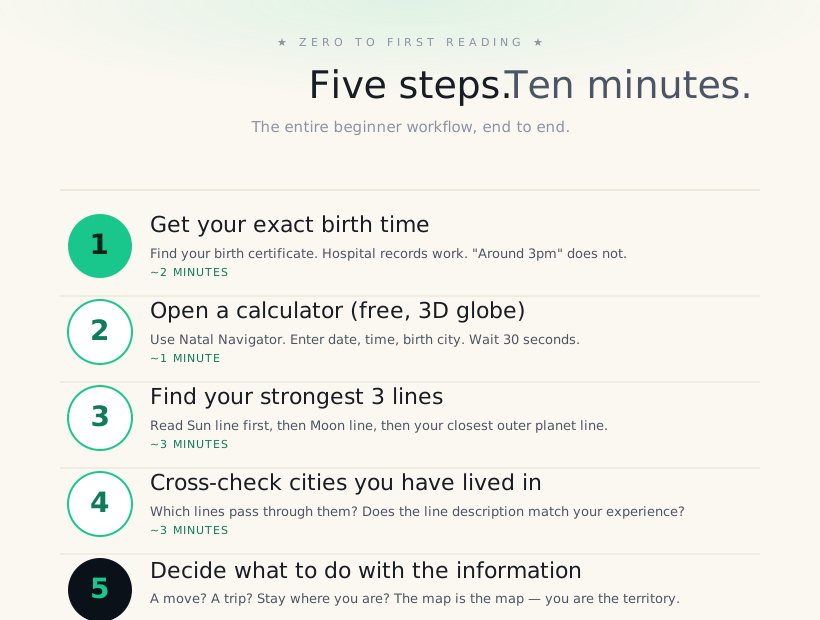
Get your exact birth time
This is the single most important input. Look at your birth certificate, hospital records, or ask family. "Around 3pm" will not work — Ascendant and Descendant lines shift by hundreds of kilometers per minute of birth-time error.
If you cannot find your exact time, you can still get useful MC and IC line readings (those depend more on birth date than birth time). For ASC and DC lines, treat the results as approximate until you confirm the time.
Open a free 3D-globe calculator
For 2026, the best free option is Natal Navigator because it renders the 40 lines on a real 3D globe you can rotate — much easier to interpret than the legacy flat 2D maps used by older calculators. Enter your birth date, exact birth time, and birth city. The globe renders in about 30 seconds.
Alternatives: AstroSeek or AstroChart.co (both free, both 2D flat maps). See our calculator comparison for trade-offs.
Find your strongest three lines
Forty lines is overwhelming. Read these three in this order:
- Your Sun line — strongest single line. Identifies where you shine and are most visibly yourself.
- Your Moon line — second strongest. Identifies where you feel emotionally at home.
- Your closest outer-planet line — whichever of Jupiter, Saturn, Uranus, Neptune, or Pluto passes nearest to where you live or are considering. Outer planets carry the most transformative energy.
These three lines explain about 80 percent of what astrocartography has to say about your specific chart. Everything else is refinement.
Cross-check cities you have actually lived in
This is the validation step that nobody tells beginners about, but it is the most useful thing you can do. Look at the cities where you have actually lived for longer than a few months. Which lines pass through (or near) those cities? Does the standard interpretation for those lines match your remembered experience?
If yes — the tool has earned a degree of credibility for your specific chart. If no — be more skeptical of future predictions. Either way, you have learned something real, not borrowed.
Decide what to do with the information
The chart is data. The decision is yours. Are you moving? Taking a trip? Setting expectations for the city you are already in? Considering a different career location?
For most beginners, the most useful first decision is small: pick one city on a Sun or Jupiter MC line and visit for a long weekend. See if the experience matches the interpretation. You learn faster from one visit than from ten hours of reading.
The vocabulary you need (and only this much)
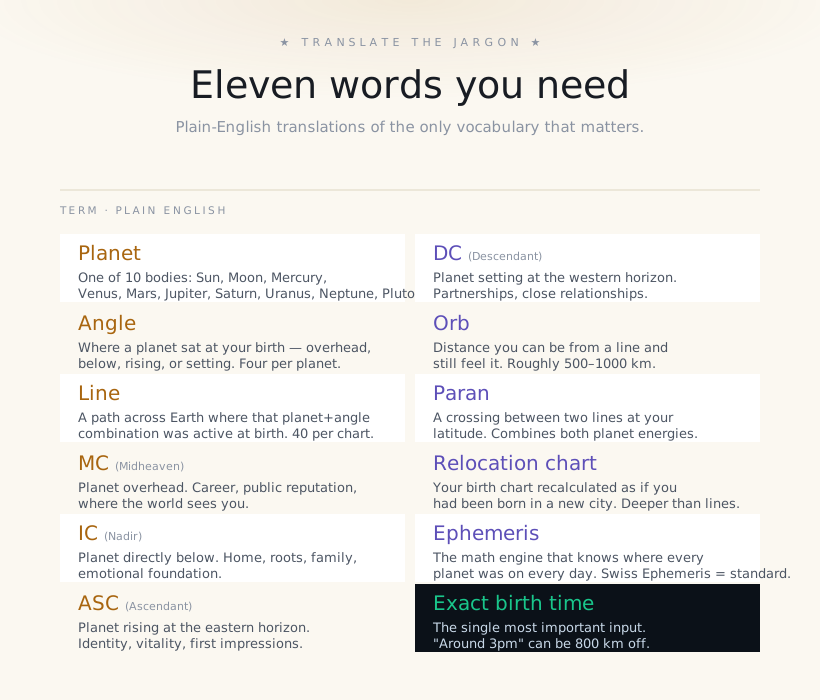
Astrocartography has accumulated decades of jargon. As a beginner, you do not need most of it. These eleven words cover 95 percent of any blog post, podcast, or chat conversation you will encounter:
- Planet — one of ten bodies: Sun, Moon, Mercury, Venus, Mars, Jupiter, Saturn, Uranus, Neptune, Pluto.
- Angle — where a planet sat at your birth: overhead, below, rising, or setting. Each planet has four angles.
- Line — a path across Earth where one specific planet-and-angle combination was active at your birth. 40 lines per chart.
- MC (Midheaven) — planet directly overhead. Career, public reputation, visibility.
- IC (Nadir) — planet directly below. Home, roots, family, emotional foundation.
- ASC (Ascendant) — planet rising on the eastern horizon. Identity, vitality, first impressions.
- DC (Descendant) — planet setting on the western horizon. Partnerships, close relationships.
- Orb — how far from a line you can be and still feel its effect. Roughly 500-1000 km depending on planet.
- Paran — a crossing of two lines at your latitude. Combines both planet energies, often felt from very far away.
- Relocation chart — your birth chart recalculated as if you had been born in a new city. Goes deeper than astrocartography lines.
- Ephemeris — the astronomical math engine that knows where every planet was on every day. Swiss Ephemeris is the standard.
Memorise these. Skip the rest until they actually appear in something you are trying to read.
What to safely ignore for your first three months
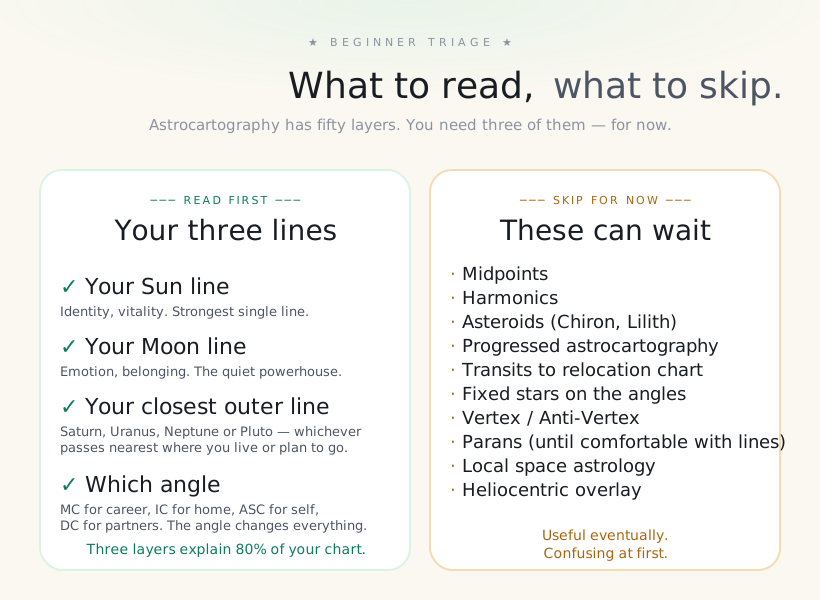
Astrocartography literature contains many advanced concepts that experienced practitioners argue about. As a beginner, you can safely ignore all of them for the first three months. Specifically:
- Midpoints — calculated halfway-points between planet pairs. Useful eventually, confusing at first.
- Harmonics — alternative chart calculations using non-standard divisions of the zodiac. Niche.
- Asteroids (Chiron, Lilith, Ceres) — additional bodies beyond the classical ten. Useful for specific themes.
- Progressed astrocartography — how your lines symbolically shift as you age. Advanced.
- Transits to relocation chart — current planetary transits interpreted against your relocated chart. Requires deep astrology knowledge.
- Fixed stars — bright background stars projected onto chart angles. Traditional but obscure.
- Vertex and Anti-Vertex — additional sensitive points beyond the four classical angles. Specialist territory.
- Parans — useful eventually, but read your visible lines first.
- Local space astrology — separate technique using compass directions from your location. Worth its own learning curve later.
- Heliocentric overlay — astrocartography from the Sun's perspective instead of Earth's. Niche.
None of these are wrong. They are just refinements. Master your Sun line first.
Five mistakes beginners make
- Estimated birth time — using "around 3pm" instead of a real time. Wrecks ASC/DC accuracy.
- Reading only the planet, not the angle — "Venus" is not a complete reading. "Venus MC" and "Venus DC" mean different things.
- Moving for a Pluto line during a vulnerable period — Pluto rewards readiness, not desperation. Wait.
- Assuming the line will fix what only inner work can fix — a Venus DC line will not give you love if you arrive hating yourself.
- Trying to read all 40 lines at once — analysis paralysis. Read three. Test one. Iterate.
Where to go next as you get more comfortable
Once you have spent a few weeks with your three primary lines, expand in this order:
- Read all 10 planetary lines to understand the full archetype set.
- Add a relocation chart for one city you are seriously considering (most calculators include this).
- Read about the accuracy debate so you can hold a critical position.
- Add parans (line crossings) — only after you are comfortable reading the visible lines.
- Optional: learn enough natal-chart astrology to read a relocated chart in depth.
Open your first astrocartography chart now
Enter your birth date, exact time, and city. See all 40 of your planetary lines render on an interactive 3D globe in 30 seconds. The demo is free; your own chart is a one-time €9.99, no subscription.
Create my map — €9.99 → Try the live demo →Frequently asked questions
What is astrocartography in one sentence?
A branch of astrology that projects your birth chart onto a map of the Earth, showing 40 planetary lines — 10 planets × 4 angles (MC, IC, ASC, DC) — where each planet was at a key position when you were born.
Do I need to know astrology first?
No. Astrocartography is one of the most beginner-friendly astrology branches because the core idea is spatial — lines on a map. You can read it usefully in ten minutes without learning houses, aspects, or signs.
What do I need for my first reading?
Exact birth date, exact birth time (from a certificate, not estimated), and birth city. Plus a free 3D-globe calculator like Natal Navigator.
Why does the exact birth time matter so much?
Ascendant and Descendant lines shift by hundreds of kilometers per minute of birth-time error. An estimated time can place your ASC line on the wrong side of a major city.
What if I cannot find my exact birth time?
Focus on MC and IC lines (less sensitive to birth time). Or get a "rectification" from an experienced astrologer who works backwards from major life events.
Where do I start reading my chart?
Sun line first (identity, visibility), then Moon line (emotion, home), then your closest outer-planet line (Jupiter through Pluto). These three explain about 80 percent of your chart.