Astrocartography hides several questions inside the word “accurate”: how precisely a tool computes planetary positions, how reliably birth data and time zones are known, how lines are projected, and whether the traditional life meanings have scientific support. Those questions need separate answers.
This piece does the unpopular thing: it takes the question seriously enough to separate it cleanly. We walk through what the math actually does, what evidence does and does not exist, what the skeptic's case is, what the believer's case is, and how to use astrocartography either way — including the pragmatic uses that do not require belief in anything.
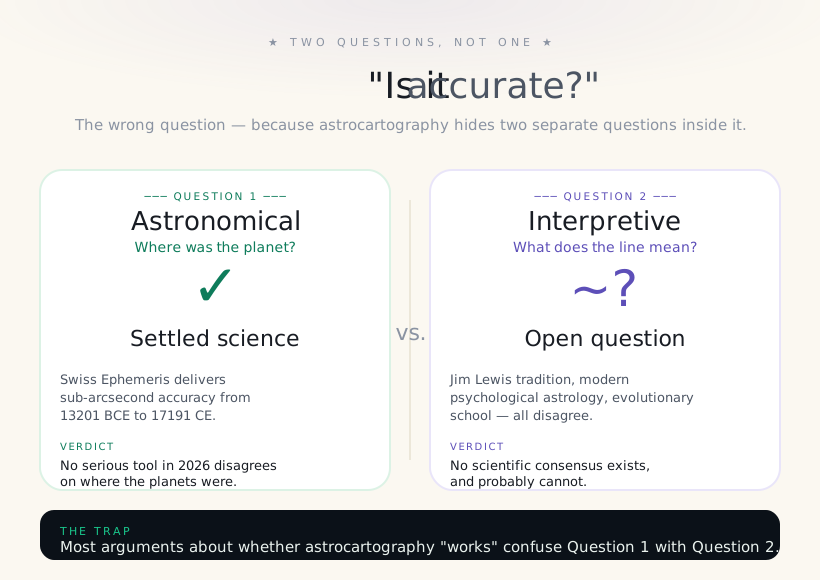
Question 1: What does the software document?
Planetary positions are computable, but “computer-generated” does not mean infinitely precise. Natal Navigator uses the open-source Astronomy Engine, whose official documentation describes typical geocentric position accuracy within approximately one arcminute.
The final map adds other inputs and transformations: recorded birth time and place, historical time-zone conversion, angular-line solving and geographic projection. Two products can therefore differ even when their ephemeris inputs are similar. A responsible accuracy statement names the engine and its documentation, then states the remaining uncertainty.
Natal Navigator's current implementation and correction process are summarized on the methodology page.
Question 2: The meaning is open.
Here is where the trouble starts. Saying "the Sun was over Berlin at the moment of your birth" is one kind of claim. Saying "therefore Berlin will amplify your vitality and visibility" is a fundamentally different kind of claim. The first is astronomical. The second is interpretive — and interpretation is where every working astrocartographer of the last fifty years has argued with every other.
The dominant interpretive frame is Jim Lewis's original system from the 1970s. Lewis took natal-chart house meanings and projected them onto the four angles: Midheaven = career, Nadir = home, Ascendant = identity, Descendant = relationships. Layered on top of planetary archetypes that go back to Hellenistic astrology. This is the system most online calculators implement and the one most readers experience.
But there are at least three competing frames:
- Modern psychological astrology — treats lines as activations of inner archetypes rather than external fates. Same lines, different language: "Pluto on the IC" means inner transformation, not external catastrophe.
- Evolutionary astrology — sees lines as karmic indicators tied to soul-purpose decisions across lifetimes. Heavy weight on outer planets.
- Empirical/post-Lewis schools — try to keep what client experience confirms and discard what does not. The most rigorous variant attempts to track measurable outcomes (income, marriage rates, health markers) for people who moved to specific lines. Limited dataset.
These frames give materially different readings of the same chart. The Lewis frame says a Saturn MC line is hard work. The evolutionary frame says it is karmic completion. The psychological frame says it is internal authority-building. The same person standing in the same city receives three different interpretations.
What evidence actually exists
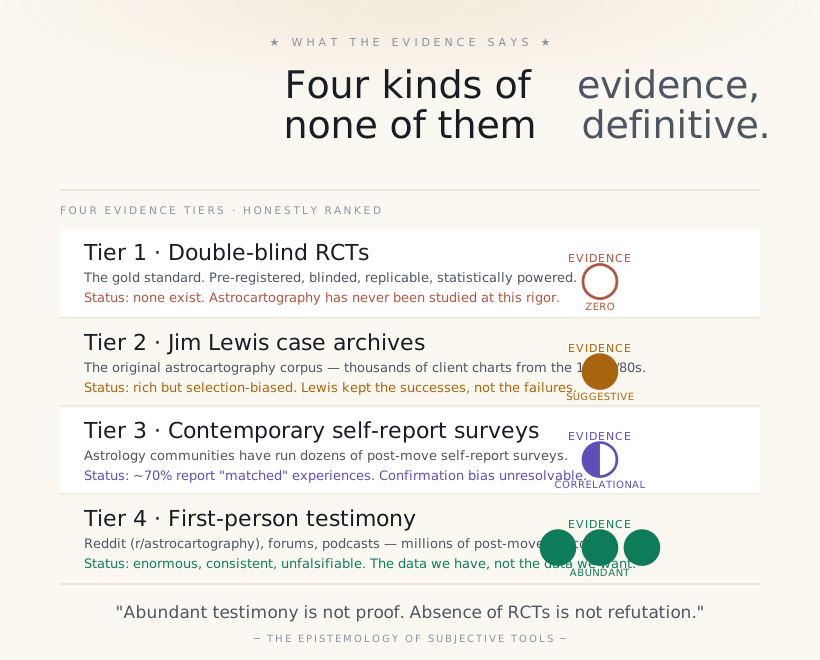
Tier 1: Double-blind randomised controlled trials
None exist. Astrocartography has never been studied at this level of rigor. This is the gold standard for medical claims and the gold standard against which serious metaphysical claims would have to be measured if anyone wanted to settle the question. The closest analogue is Geoffrey Dean's career-long research into general astrology (notably the 1985 Carlson study published in Nature), which found astrologers performed at chance when blinded — but that work targeted natal chart interpretation, not astrocartography specifically.
Tier 2: Jim Lewis's case archives
Lewis himself amassed thousands of client charts during the 1970s and 80s and published The Psychology of Astro*Carto*Graphy based on patterns he saw. The corpus is rich and includes many vivid case studies, but suffers from a fatal selection bias: Lewis kept the successes, not the failures. We have no way to know how many clients moved to a Sun line and nothing happened, because those clients did not return as data.
Tier 3: Contemporary self-report surveys
Community self-reports can describe experiences but cannot establish a reliable match rate without a published sampling frame, questionnaire, denominator and analysis. Selection and confirmation bias are especially strong when participants already know the predicted line meaning. We therefore do not present an unsourced percentage as a reproducible result.
Tier 4: First-person testimony
This is the largest dataset by orders of magnitude. Reddit (r/astrocartography), astrology Discord servers, podcasts, and YouTube comment sections contain millions of detailed post-move anecdotes. Three patterns repeat with striking consistency: (1) Moon-line moves cause emotional unburdening that surprises even skeptical movers; (2) Saturn-line moves are described as "hard but useful" with consistency that would be hard to fake; (3) Pluto-line moves produce identity collapses that movers describe in remarkably similar language across cultures.
This is not proof. It is, however, an enormous amount of consistent qualitative data that scientific methodology has not engaged with seriously.
"The plural of anecdote is not data, but the absence of data is not evidence of absence either. Astrocartography lives in the gap, and it will probably stay there."
— Geoffrey Cornelius, "The Moment of Astrology" (1994)The skeptic's case, taken seriously
A serious skeptic would point out several things:
- No mechanism — there is no proposed physical pathway by which the position of Mars at your birth would influence the experiential quality of Berlin in 2026. The lack of mechanism is a strong prior against any effect.
- Confirmation bias is total — anyone moving deliberately to a Venus line is primed to interpret romantic moments as line-confirming. The Texas Sharpshooter Fallacy is unavoidable in self-report.
- Forer effect — line descriptions are generic enough that most people can find personal resonance in any of them. "You will experience growth on a Jupiter line" applies to nearly every move because nearly every move involves growth.
- Survivorship bias in testimony — people who had a great Sun-line move write blog posts. People whose Sun-line move was unremarkable do not.
None of this is wrong. Any honest astrocartographer working in 2026 has to face it.
The believer's case, taken seriously
A serious believer would respond with several things:
- Mechanism is not required for effect — we accepted gravity for centuries before Einstein explained it. Demanding mechanism before accepting observation puts the cart before the horse.
- The consistency across cultures — Korean and Brazilian and German Reddit users describe Pluto-line experiences in nearly identical language. Cultural cross-validation argues against pure projection.
- The specificity that goes beyond the Forer effect — generic horoscope language is famously bland; astrocartography line descriptions are specific enough to be wrong. A Saturn IC line predicting family conflict is falsifiable; for many users it does not happen, and they report that too.
- Practical utility regardless of mechanism — the question "does it work?" might matter less than "does using it produce better outcomes for users?". The answer to that, based on self-report, is meaningfully positive.
Neither side wins this argument cleanly. That is the actual epistemic situation.
How to use astrocartography without belief
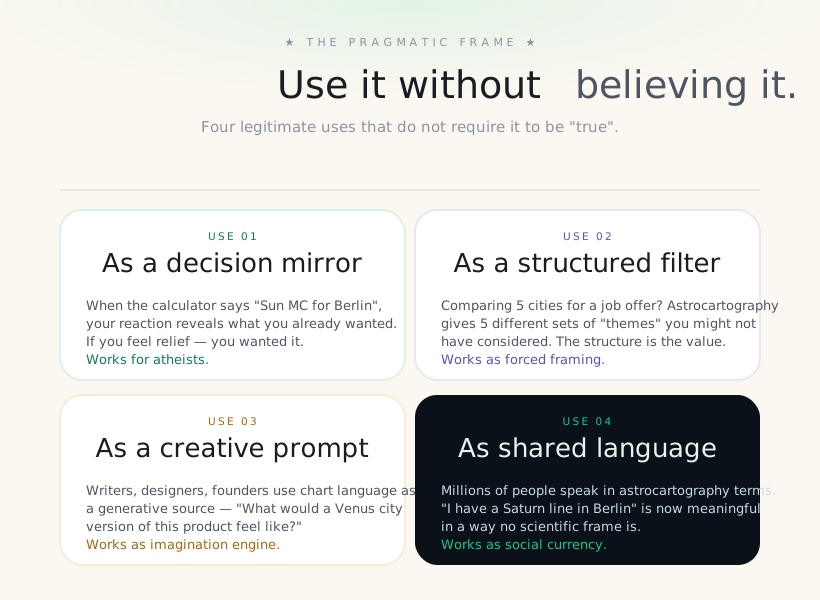
The most useful frame for a thoughtful skeptic is to treat astrocartography as a structured thinking tool. Four legitimate uses do not require belief:
1. As a decision mirror
When the calculator says "Berlin is a Sun MC city for you", watch your reaction. Do you feel a quiet relief? You wanted Berlin. Do you feel resistance? You did not. The tool is not telling you about Berlin; it is telling you what you already knew about yourself but had not articulated.
2. As a structured comparison filter
Choosing between five cities for a job offer? Astrocartography forces you to consider each through five different lenses (career line, home line, partnership line, etc.) that you might not have applied on your own. The forced structure is the value — even if you reject the interpretations.
3. As a creative writing prompt
Founders, writers, designers, and strategists increasingly use astrology language as a generative source. "What would a Venus version of this product feel like?" generates better ideas than "what would a more romantic product feel like?" because the constraint is unfamiliar enough to push past stale framings.
4. As shared cultural vocabulary
Whether or not you believe it, millions of people now speak in astrocartography terms. "I have a Saturn line in Berlin" is shorthand that conveys something specific and meaningful in a way no scientific framework currently does. Speaking the language costs you nothing and gives you fluency with a real cultural moment.
Five common errors to avoid either way
- Using estimated birth time — Ascendant lines shift by hundreds of kilometers per minute of birth-time error. If you do not have an exact time from your birth certificate, your ASC/DC lines are speculative.
- Ignoring the four-angle distinction — Venus MC and Venus DC are not the same line. The angle matters more than the planet.
- Reading only the nearest line — parans (line crossings at your latitude) can dominate the chart from far away.
- Over-weighting outer planets for short decisions — Pluto and Neptune act over years, not weeks. Do not move to a Pluto line for a six-month internship.
- Attribution bias after a move — when something good happens after moving to a Jupiter line, you cannot know if Jupiter caused it or if the move itself did.
When astrocartography is genuinely useful
From thousands of user conversations, astrocartography proves most useful in four scenarios:
- You have several genuinely viable city options and need structured differentiation. The lines force comparison.
- You have already decided to move and want to set expectations. The interpretations prime useful narratives for the new place.
- You are doing creative or strategic work and need fresh framing. The archetypal language unlocks unfamiliar perspectives.
- You are processing a past move that did not work. The vocabulary helps name what changed without requiring causal claims.
It is least useful when used as permission to escape an unaddressed inner problem, or when expecting a city to fix what only inner work can fix.
See your own lines and decide for yourself
The fastest way to evaluate any tool is to use it on your own data. Enter your birth chart, see your 40 planetary lines on a 3D globe, and decide what they mean for you. The demo is free; your own chart is a one-time €9.99, no subscription.
Create my map — €9.99 → Try the live demo →Frequently asked questions
How accurate is astrocartography?
Several questions hide inside: software precision, birth-data and time-zone accuracy, projection geometry and symbolic interpretation. Natal Navigator's engine documents typical geocentric accuracy within about one arcminute; astrological meanings are not scientifically validated.
Has astrocartography been scientifically proven?
No established body of controlled, replicated evidence validates the location meanings. Case archives, self-reports and testimony are vulnerable to selection and confirmation bias.
Why has no one done rigorous studies?
Effects are large but vague (hard to operationalise), participants self-select for belief (breaks blinding), academic funding does not flow toward astrological research.
Should a skeptic use astrocartography?
Yes, for four pragmatic reasons that do not require belief: as a decision mirror, as a structured comparison filter, as a creative prompt, as shared cultural vocabulary.
Most common errors in reading?
Estimated birth time, ignoring four-angle distinction, reading only nearest line, over-weighting outer planets for short decisions, post-move attribution bias.
When is astrocartography genuinely useful?
Comparing viable city options, setting expectations after a move decision, creative/strategic work, processing past moves. Not useful for escapism.