Use astrocartography first — it shows you all your planetary lines across the whole Earth in ten minutes. Use a relocation chart second — it gives you a full natal-chart-level reading for one specific city in two to three hours. The first is for exploration; the second is for decision.
Astrocartography
Takes your birth chart and projects four key positions (MC, IC, ASC, DC) for each of ten planets across the entire globe as lines. The output is a world map (or 3D globe) with 40 visible paths.
Best for: initial exploration. "Which cities even deserve consideration?"
Relocation chart
Takes your birth chart and recalculates everything — houses, planetary placements, aspects, midpoints — as if you had been born at the new city's coordinates instead. The output is a complete second natal chart.
Best for: deep reading of one specific city you are seriously considering.
The eight differences in detail
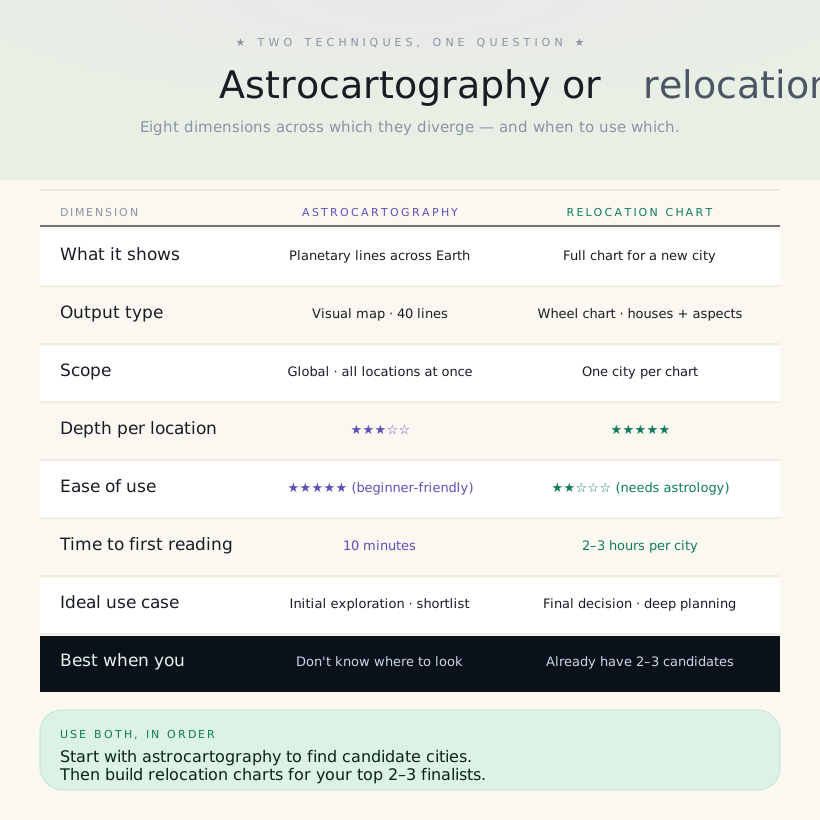
1. What each shows
Astrocartography shows planetary lines crossing the Earth. A relocation chart shows a complete second natal chart for one city. The first is a map; the second is a wheel.
2. Output type
Astrocartography produces a visual artifact — lines on a globe or map. A relocation chart produces an astrological chart that looks identical in format to a natal chart but with different house cusps and planetary placements.
3. Scope
Astrocartography is global by design — every location on Earth in one view. A relocation chart is single-city by design — one new place, one new chart. To compare five cities with relocation, you build five charts.
4. Depth per location
Astrocartography gives you broad themes per line crossing your city. A relocation chart gives you the full natal-astrology toolkit: houses, aspects, midpoints, fixed-star contacts, etc. The depth difference is approximately ten-fold.
5. Ease of use
Astrocartography is beginner-friendly because the core idea (lines on a map) is spatial and intuitive. A relocation chart requires basic astrology literacy — understanding houses, aspects, and the architecture of a natal chart.
6. Time to first reading
Astrocartography: ten minutes from birth data to a useful global reading. Relocation chart: two to three hours per city for a deep reading. The asymmetry is significant.
7. Ideal use case
Astrocartography is for the exploration phase — you have no clear candidate cities and need to discover which deserve attention. Relocation charts are for the decision phase — you have two or three candidates and need to evaluate them in depth before committing.
8. What you actually do with each
With astrocartography, you scan and shortlist. With a relocation chart, you live in the chart mentally — running through each house, each aspect, each placement, and asking "what would daily life feel like with these patterns activated?"
How to use both, in order
- Open your astrocartography map first. See which lines cross which continents. Note any city of interest where one or two lines pass within 500 km.
- Shortlist three to five candidate cities based on which lines are strongest there. Use the three-factor method to rank them.
- Build relocation charts for the top two or three. Spend an hour with each. Read the houses, the angles, the aspects to natal planets.
- Compare the relocation charts side by side. The one that feels most coherent and most aligned with your current life stage is the answer — for now.
If you can only use one
Pick astrocartography. Reasons:
- It is faster, free, and beginner-friendly.
- It covers the entire Earth at once, surfacing options you would not have considered.
- For 80 percent of practical decisions (where should I move, where should I take this trip, why did this city feel hard), the line-level reading is enough.
- If a single line strongly clarifies things for you, you do not need the relocation chart layer.
Relocation charts add real depth in the final 20 percent of cases — typically when two cities tie at the astrocartography level and you need a tiebreaker, or when you are making a high-stakes long-term move where the extra precision is worth two hours.
Start with astrocartography — it is faster
The 3D globe shows you all 40 planetary lines in 30 seconds. Shortlist your candidate cities, then build relocation charts only for the finalists.
Create my map — €9.99 → Try the live demo →