Read in this order: verify birth time, locate home, read closest line, find Sun and Moon lines, note outer-planet lines, check for parans, validate against past cities. Reading out of order is how beginners end up with contradictory readings and abandoned charts.
An astrocartography map looks overwhelming the first time you open one. Forty lines crossing every continent, four angles per planet, a glossary nobody fully agreed on. The trick is not to learn more vocabulary — it is to read in a fixed order that resolves ambiguity before it appears. This piece gives you that order.
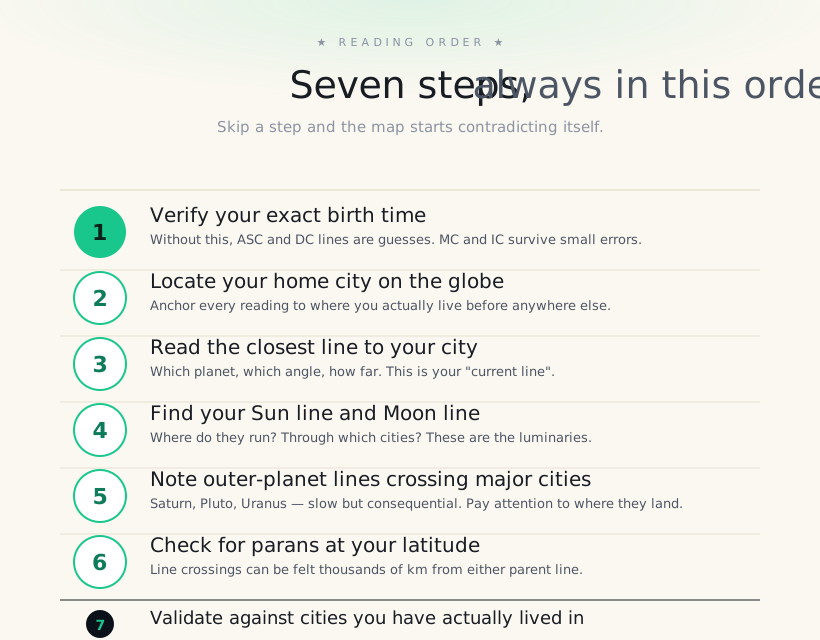
The seven steps in detail
Verify your exact birth time
This is the foundation. Without it, the entire map is partly speculation. Birth certificate first; hospital records second; estimated time only as last resort.
If you must use an approximate time, weight MC and IC lines (slightly less time-sensitive) more heavily and treat ASC/DC lines as approximate. Or get a rectification from a professional astrologer.
Locate your home city on the globe
Before exploring anywhere exotic, rotate to where you actually live. Every meaningful reading starts from your current location and expands outward. The map is not "what cities should I move to" — it is "what is happening here, and what would shift if I moved".
If you have not lived anywhere long-term yet, anchor to your birth city instead. It will still teach you the map.
Read the closest line to your current city
Identify the planet, the angle, and the distance in kilometers. Use the three-factor method if more than one line is close. This is your "current line" — the dominant astrocartographic energy of where you are now.
Compare its standard interpretation with your actual experience of the city. If they match, the tool has earned credibility for your chart. If they do not, become more skeptical of future predictions.
Find your Sun line and your Moon line
These are the luminaries — the two strongest archetypes in any chart. Note which cities they pass through. If either crosses a place you have lived or are considering, it deserves close attention.
Sun and Moon lines are also useful as reference: even when they are far from you, knowing where they run gives you mental anchors for the rest of the map.
Note outer-planet lines crossing major cities
Saturn, Uranus, Neptune and Pluto carry the most transformative weight but act slowly. A Pluto line crossing London, Berlin, or São Paulo deserves a mental flag — even if you have no plans to move there. These cities will be different for you than for someone with a different chart.
Pay particular attention to outer-planet lines crossing cities where you have business connections, family, or potential future obligations.
Check for parans at your latitude
A paran is a crossing of two planetary lines at the same latitude. It transmits combined energy to cities at that latitude even if both parent lines are far away.
If your latitude has a Sun-Jupiter paran, every city on that horizontal band carries some of that combined energy. Most calculators flag parans separately. Read them as supplementary, not primary.
Validate against cities you have actually lived in
The single most important credibility check. Look at every city where you have lived for longer than three months. Which lines passed through them? Does the standard interpretation match your remembered experience?
If yes, you have personal validation. If no, you have a healthy reason to be skeptical of the tool. Either result is useful.
Common reading errors to avoid
- Reading dream cities first. The map cannot be tested against a city you have never visited. Anchor to known places.
- Cherry-picking lines that "feel right". The order exists to prevent confirmation bias. Read what the calculator shows, not what you want it to show.
- Ignoring distance. A Sun line 1500 km away has almost zero effect. Proximity multiplies archetype rank.
- Mixing schools mid-reading. If you started with the Jim Lewis interpretation, finish with it. Switching to evolutionary or psychological frames mid-chart creates incoherent readings.
- Reading more than five lines deeply. Beyond five, returns diminish sharply. Master the strongest few first.
Read your own chart on a 3D globe
Enter your birth data. Rotate to your home city. The seven steps take about ten minutes — and the chart will never feel overwhelming again.
Create my map — €9.99 → Try the live demo →