Your strongest astrocartography line is whichever planet's line scores highest when you multiply three things: archetype rank × proximity to you × angle weight. The Sun line is the highest-ranked archetype, but a Pluto line that runs through your city beats a Sun line 1000 km away. Distance dominates rank at long distances.
If you have opened your first astrocartography chart and counted forty lines, your reasonable next question is which one of these actually matters for me. Astrology forums answer this badly. Most posts say something like "the Sun line is the strongest" without explaining that strongest where matters as much as strongest which. This piece gives you a clean three-factor method that resolves the ambiguity.
The three-factor method
Three independent factors decide which of your forty lines is dominant for a given location. Each factor varies in degree, and they multiply rather than add — meaning one weak factor can kill an otherwise strong line.
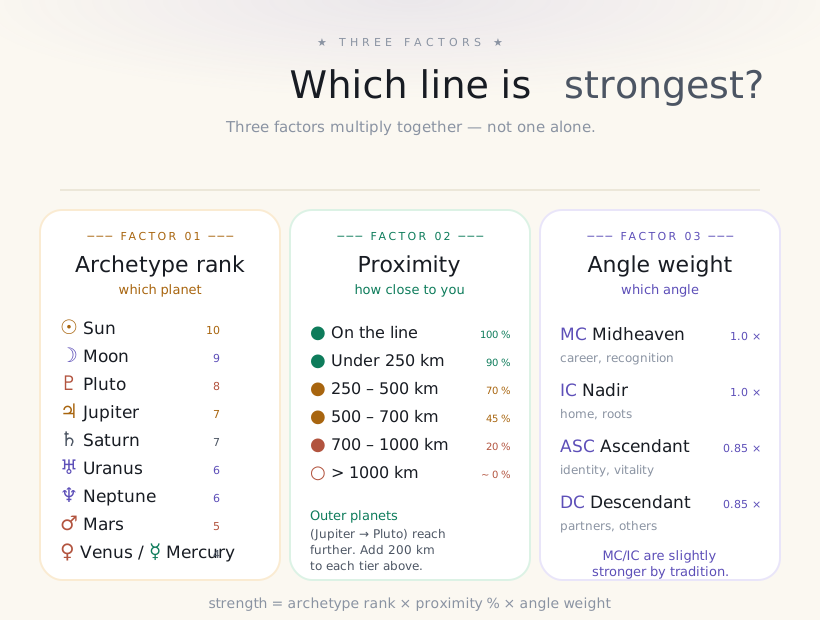
Factor 1: Archetype rank
Not all planets carry equal weight in astrocartography. The classical hierarchy, which most schools agree on with minor reordering, runs:
- Sun (10) — strongest archetype. Identity, vitality, public self.
- Moon (9) — second strongest. Emotion, belonging, deep memory.
- Pluto (8) — most transformative of the outer planets.
- Jupiter and Saturn (7) — major life-shapers; expansion and structure.
- Uranus and Neptune (6) — disruption and dissolution; act slowly.
- Mars (5) — high-energy but narrower domain (action, conflict).
- Venus and Mercury (4) — significant but more subtle daily effects.
These numbers are not scientifically derived; they reflect the weighting used by working astrologers since the Jim Lewis tradition formalised the practice in the 1970s. Treat them as a heuristic, not a measurement.
Factor 2: Proximity
This is the factor most beginners underweight. Astrocartography lines weaken with distance — quickly, not gradually. A Pluto line 50 km from your city is meaningfully active in your daily life. The same Pluto line 1200 km away does almost nothing.
Empirical orb conventions for personal planets and luminaries:
- On the line (within ~50 km): 100% effect
- Under 250 km: 90% effect
- 250–500 km: 70% effect
- 500–700 km: 45% effect
- 700–1000 km: 20% effect
- Beyond 1000 km: near zero
Outer planets (Jupiter through Pluto) have orbs roughly 200 km wider at each tier, because their energies are slower and more diffuse. A Pluto line at 1200 km can still register; a Mercury line at 1200 km usually cannot.
Factor 3: Angle weight
Each planet produces four lines based on its position relative to the horizon at your birth. The four angles carry slightly different weight in the tradition:
- MC (Midheaven, 1.0×) — full weight. Career, public identity.
- IC (Nadir, 1.0×) — full weight. Home, roots, family.
- ASC (Ascendant, 0.85×) — slightly lighter. Self-expression, vitality.
- DC (Descendant, 0.85×) — slightly lighter. Partnerships, what you attract.
The MC and IC are traditionally weighted slightly higher because they relate to the visible vertical axis of the chart — the planet directly overhead and directly below. ASC and DC depend more sensitively on exact birth time, which is why some practitioners discount them by about 15 percent unless the birth time is rectified.
A worked example
Suppose you live in Berlin. Two lines pass nearby:
- Line A: Sun MC, 600 km away
- Line B: Pluto IC, 100 km away
Which wins?
- Line A: 10 (Sun) × 45% (500–700 km) × 1.0 (MC) = 4.5
- Line B: 8 (Pluto) × 90% (under 250 km) × 1.0 (IC) = 7.2
Pluto IC wins. Not because Pluto is "stronger than the Sun" — it is not — but because at this location the Sun line has weakened so much that Pluto, with proximity on its side, dominates the actual lived experience. Berlin would feel like a Pluto-IC city, not a Sun-MC city.
This is the most common misreading by beginners: assuming the Sun line is always the answer. It often is — but only when it actually passes nearby.
How to find yours in five minutes
The fastest path:
- Open the interactive 3D globe with your birth data. Wait 30 seconds for the lines to render.
- Rotate to your current city or any city you are considering. Most 3D-globe calculators automatically show distance to each nearby line.
- List the three closest lines by km. Note which planet and which angle each one is.
- Multiply archetype rank × proximity % × angle weight for each. Highest score wins.
For most cities, you will find one clear winner with a score 1.5–3× higher than the runner-up. That is your dominant line. If you find two lines tied within 20%, you have a paran-like situation — both energies are active and the city carries a mixed character.
What to watch out for
- Estimated birth time can move ASC/DC lines by hundreds of km, invalidating proximity calculations. If your time is approximate, weight MC/IC lines more heavily.
- Parans (line crossings at your latitude) can dominate from very far away. Most 3D-globe tools flag these separately.
- Your strongest line changes when you move. Proximity is location-specific. A different city activates a different dominant line — that is the entire point of astrocartography.
- Strongest is not always "best". A dominant Saturn line at your IC is strong; it is also hard. Strength is about activation, not desirability.
Find your strongest line in 90 seconds
Enter your birth data. The globe shows you all 40 lines and ranks the closest ones by distance — the multiplication is done for you.
Create my map — €9.99 → Try the live demo →Frequently asked questions
What is my strongest astrocartography line?
The one that scores highest when you multiply archetype rank (Sun=10, Moon=9, Pluto=8, etc.) × proximity to you (100% on line, dropping to near zero beyond 1000 km) × angle weight (MC/IC = 1.0, ASC/DC = 0.85).
Is the Sun line always the strongest?
Often, but not always. A Pluto line 100 km from you beats a Sun line 1000 km away. Distance dominates rank at long distances.
How do I know which lines pass close to me?
Use a 3D-globe calculator like Natal Navigator — rotate to any city and the distances to all nearby lines are shown automatically.
Can my strongest line change?
Yes, when you move. Proximity is location-specific; a new city activates a different dominant line.