Astro-Seek astrocartography is a quiet favourite for a reason: it is completely free, astronomically accurate, and bottomless in classical depth. If you have ever wanted progressions, returns and a parans table layered onto your relocation map without paying a cent, Astro-Seek delivers. But there is a moment — usually right after the map loads — where many people stall. The lines are all there; the next step, "so where do I actually go?", is left entirely to you. This walkthrough covers what Astro-Seek does brilliantly, where it stops, and the modern alternatives that pick up exactly where it leaves off.
Astro-Seek's astrocartography is free, Swiss-Ephemeris-accurate and unusually deep — but it draws your lines on a flat 2D map and never scores cities for you, so the decision stays manual. For a faster, visual answer, a 3D-globe tool like Natal Navigator reads the same data and rates 345+ cities against your chart. Keep Astro-Seek for classical depth; use a globe to actually decide.
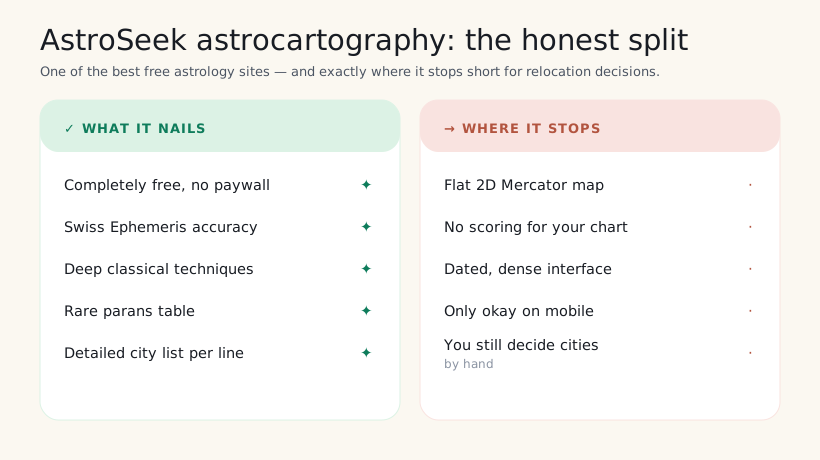
What Astro-Seek does brilliantly
Credit where it is due — Astro-Seek is one of the few free tools that never feels like a teaser for a paid upgrade:
- Genuinely free. No paywall on the astrocartography map, and none on the techniques around it.
- Swiss Ephemeris accuracy. The lines are computed on the same engine professionals use — the math is not the compromise.
- Classical depth. Progressions, solar and lunar returns, midpoints, and a parans table that almost no other free tool offers. For a completist, this is the draw.
- Detailed line data. Each line comes with a city list, so you can at least see which places sit near a given planet.
Where Astro-Seek stops
The limits are about experience, not correctness:
- A flat 2D Mercator map. It distorts toward the poles and forces you to mentally rotate the globe to picture a line's true path.
- No scoring for your chart. Astro-Seek shows the lines; it never tells you that, for your chart, Lisbon reads "thrive" and Berlin reads "caution." That synthesis is left to you.
- A dense interface. Powerful, but heavy — and only adequate on a phone, where many people now make these decisions.
If your goal is to study your chart, none of this matters. If your goal is to decide — this city or that one, this year or next — the manual work adds up. That is the gap the alternatives below close.
4 modern alternatives to Astro-Seek
Every tool here reads Swiss-Ephemeris-grade data, so you keep Astro-Seek's accuracy. What you gain is a shorter path from "map loaded" to "decision made."
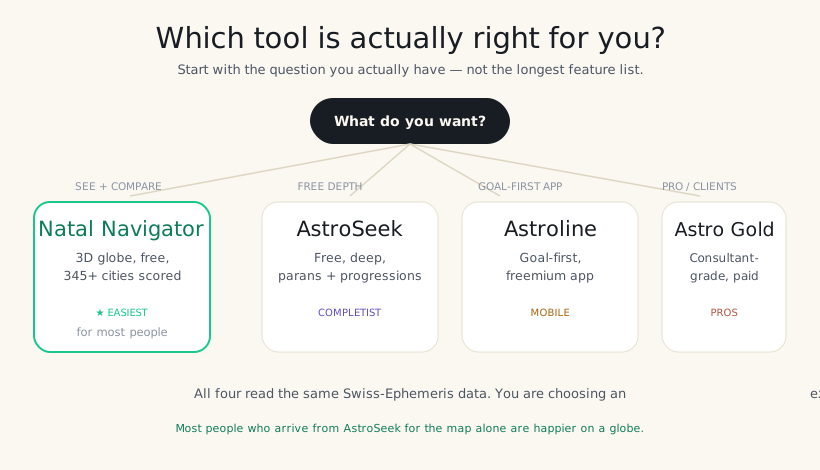
1. Natal Navigator — the visual decider
Astro-Seek's data, turned into a decision.
Natal Navigator renders all 40 of your lines on an interactive 3D globe — drag, rotate, zoom, no Mercator distortion — and then does the part Astro-Seek leaves to you: it scores 345+ cities against your specific chart as thrive, neutral or caution, with short readings for career, home and love. The demo is free to explore; your own map is a one-time €9.99 (no subscription), EN and DE. We built it precisely for the person who loves Astro-Seek's accuracy but wants the answer, not just the raw map.
Best for: deciding between real cities, fast. Keep Astro-Seek for: progressions, returns and parans.
2. Astroline — the goal-first app
Starts from what you want, not from a wall of lines.
Astroline asks whether you are chasing love, career, health or growth, then surfaces the relevant lines on a clean mobile app. Deeper readings sit behind a subscription, but as a gentle, goal-driven on-ramp it is far less intimidating than a raw map. A good fit if Astro-Seek felt like too much at once.
3. astrocartography.app — the clean free map
A simpler, more modern flat map than Astro-Seek's.
If you like Astro-Seek's price but not its density, astrocartography.app offers a cleaner, more focused free map with the ten planets drawn across the four angles. It does not match Astro-Seek's classical depth, but for a quick, readable look at your lines it is a tidy option.
4. Astro Gold — the professional's tool
When astrocartography is your job, not your hobby.
For working astrologers, Astro Gold (and Solar Fire on desktop) offers consultant-grade relocation work — transits and progressions over the map, precise control, export-ready charts. It is paid and has a real learning curve, but Astro-Seek power users who go professional often graduate to it.
Love Astro-Seek's accuracy? See it on a globe
Same Swiss-Ephemeris-grade data, none of the manual work. Enter your birth date, time and city and watch your 40 lines render on a real Earth — with cities scored for you — in about 90 seconds. Free.
Create my map — €9.99 → Try the live demo →Frequently asked questions
Is Astro-Seek astrocartography free?
Yes, fully — including progressions, returns, midpoints and a parans table, with no paywall.
How accurate is Astro-Seek astrocartography?
Very — it runs on Swiss Ephemeris. Accuracy is its strength; visualisation and city scoring are not.
What does Astro-Seek not do well?
Flat 2D map, no city scoring for your chart, dense interface. You still choose places by hand.
What is a good alternative to Astro-Seek?
Natal Navigator for an easy 3D globe with scored cities; Astroline for goal-first mobile; Astro Gold for professionals.
Astro-Seek or Natal Navigator?
Both: Natal Navigator to decide visually, Astro-Seek to go deep on classical techniques. They complement each other.